
The Book Corner · 001
Why do great ideas fail?
The Lean Startup
Eric Ries
The central idea
The purpose of a startup is not simply to build a product. It is to discover whether a sustainable business can exist around it.
01
Building is not learning
Being able to build something is not proof it should be built. Learn what matters before spending on what doesn’t.
02
The Build–Measure–Learn loop
Build a small test, measure what people actually do, learn, repeat. The shorter the loop, the less you risk.
Build → Measure → Learn → Repeat
03
The Minimum Viable Product
An MVP is not a cheap product. It is the smallest experiment that tests what you need to know.
04
Validated learning
Compliments and clicks are not demand. Real behaviour — like paying — is the evidence that counts.
05
Pivot or persevere?
A pivot is a deliberate change based on evidence. Persistence without evidence gets expensive.
06
Where the idea becomes more complicated
Not every innovation can be validated before it exists. Balance imagination with the discipline to test value.
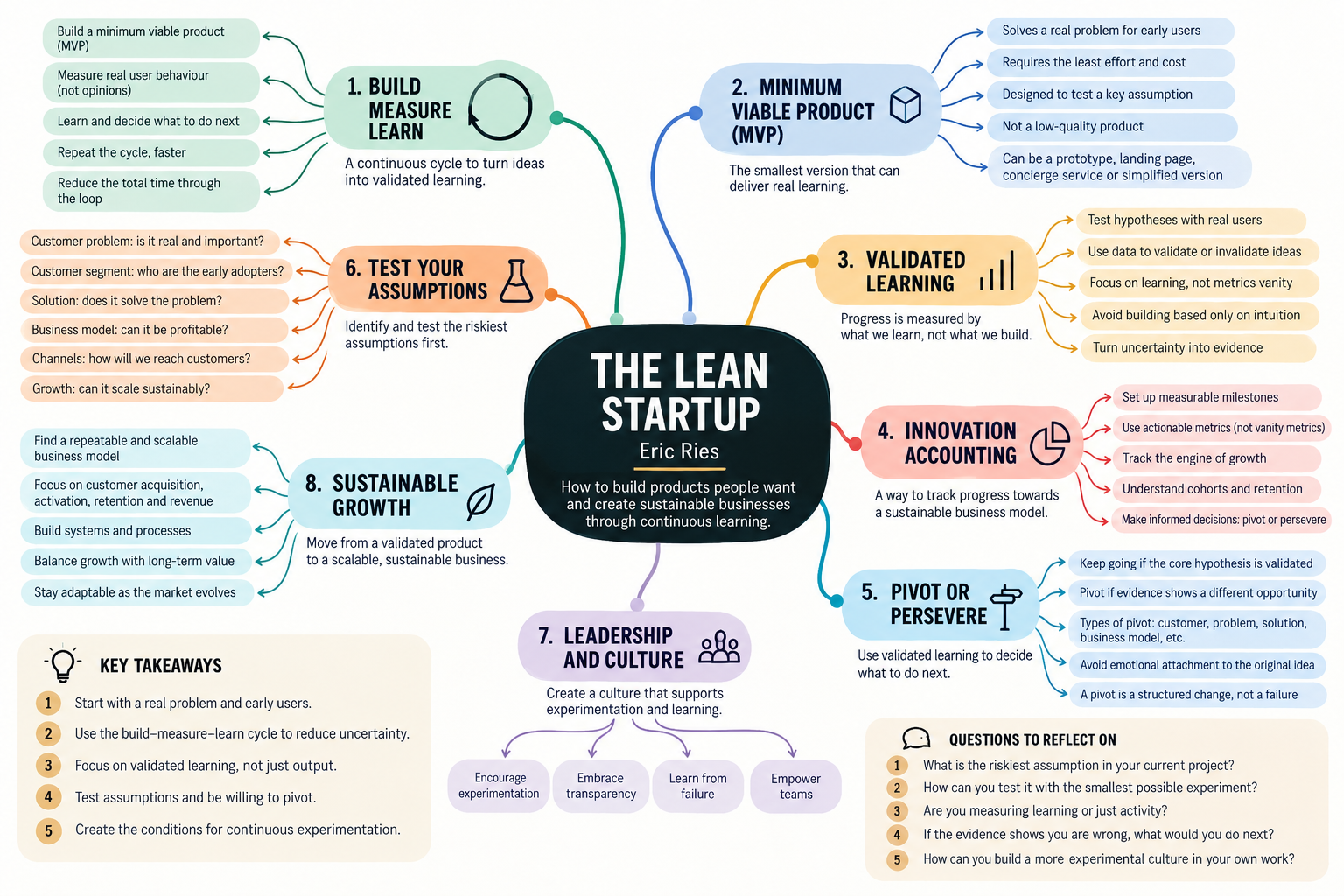
Five ideas worth remembering.
01
Progress is learning.
Activity and output are not necessarily evidence of progress.
02
Test assumptions early.
The riskiest assumptions deserve attention before the easiest tasks.
03
Measure behaviour.
What people do often tells us more than what they say.
04
Change direction deliberately.
A pivot should follow evidence, not simply frustration.
05
Protect curiosity.
Validation should inform innovation, not eliminate experimentation.
A question to take away
Before investing another month in your current project, ask yourself:
What is the most important thing I still don't know, and what is the smallest experiment that could help me find out?
That question alone might save months of unnecessary work.